Sensor-configuration transfer
paper §4.3 · Fig. 10 · Table 16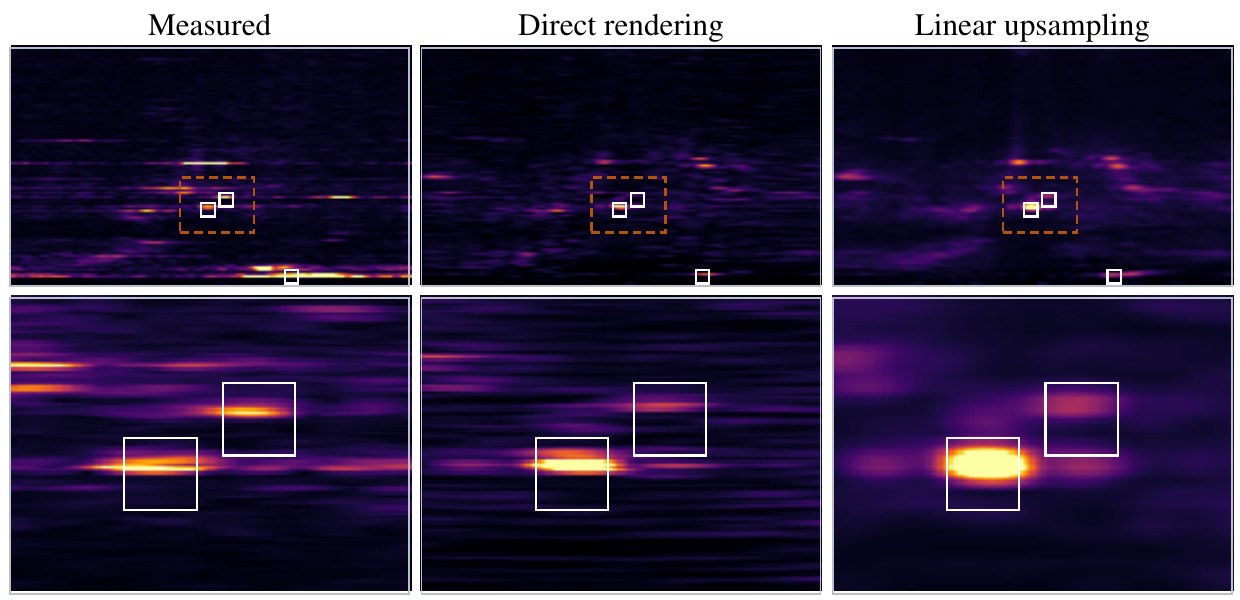
Radar Novel View Synthesis for Dynamic Driving Scenes
arXiv · 2026From recorded radar, poses and object boxes, DyRAD reconstructs the scene and renders it from new viewpoints, with edited objects and for other sensors.
DyRAD reconstructs a dynamic driving scene from recorded radar and renders full range–azimuth–Doppler tensors from poses, sensors and scene layouts it never recorded.
Reconstructing dynamic driving scenes from recorded sensor data supports closed-loop evaluation of autonomous driving systems by synthesizing observations beyond the original trajectory. Unlike cameras and LiDAR, radar measures radial velocity directly through Doppler. Yet existing radar novel-view synthesis fails to exploit this capability: methods addressing dynamic scenes reconstruct only range–azimuth tensors, while methods that render Doppler assume static scenes. Moreover, because radar processing spreads each reflection across multiple bins, existing representations absorb this spread into scene geometry, causing it to render incorrectly when the viewpoint moves.
We present DyRAD, which models dynamic driving scenes using static background reflectors and motion-tracked dynamic point reflectors to render complete range–azimuth–Doppler (RAD) tensors. Reflector velocities are derived from object tracks and projected onto the line of sight, making Doppler both a rendered output and supervision for those tracks. Crucially, we render reflectors through a fixed analytic point-spread function (PSF) derived from the radar’s signal-processing chain, preventing sensor-induced spread from being baked into the scene representation. Beyond improving scene reconstruction, this separation also enables zero-shot sensor-configuration transfer, allowing the same reconstructed scene to be rendered under different radar specifications without refitting.
We evaluate DyRAD on RADIal, Boreas, and a synthetic benchmark across both on-path poses and displaced viewpoints untested by prior work. On RADIal, DyRAD recovers radar detections in 90.7% of reference-detected objects, compared with 26.9% for the strongest baseline.
Inputs initialize the scene, the differentiable RAD renderer fits it to the recordings, and the fitted scene renders new views. Solid grey arrows show data flow; dashed red arrows show gradient flow.
Every clip shows all methods on the same scene at the same instant, on one brightness scale. ρ is the Pearson correlation with the ground truth for that frame. White boxes mark annotated vehicles. DyRAD-static keeps our point-reflector representation and renderer but treats every reflector as static and does not use the bounding boxes to separate objects during initialization. Comparing it with the full model measures the combined benefit of object separation and motion modelling. * RadarSplat and RadarFields predict only RA measurements; their Doppler is assigned from a static ego-motion model.
| RADIal · RAD reconstruction | RADIal · detection | Boreas · RA reconstruction | |||||||
|---|---|---|---|---|---|---|---|---|---|
| Method | PSNR ↑ | ρ ↑ | ρobj ↑ | CD [m] ↓ | F1 ↑ | Hit rate ↑ | PSNR ↑ | ρ ↑ | ρobj ↑ |
DyRAD-static keeps our point-reflector representation and renderer but treats every reflector as static and does not use the bounding boxes to separate objects during initialization. Comparing it with the full model measures the combined benefit of object separation and motion modelling.
Or Litany acknowledges support from the Israel Science Foundation (grant 624/25) and the Azrieli Foundation Early Career Faculty Fellowship. The authors gratefully acknowledge this support. This research was supported by the Council for Higher Education in Israel under the Moonshot Project.
@article{keidar2026dyrad,
  title         = {DyRAD: Radar Novel View Synthesis for Dynamic Driving Scenes},
  author        = {Keidar, Merav and Borreda, Tomer and Nandakumar, Rajalakshmi and Litany, Or},
  journal       = {arXiv preprint arXiv:2609.39841},
  year          = {2026},
  eprint        = {2609.39841},
  archivePrefix = {arXiv},
  url           = {https://arxiv.org/abs/2609.39841}
}